Lost and Found Part 2

This fall I received an email from Liz Ainslie. Liz is a friend and an artist living in New York City. Liz informed me that she was out with another friend of mine Maanik Singh Chauhan and they spotted one of my paintings in an antique store. Maanik saw the painting first and noted my signature on the back. I guess the painting was a bargain because Maanik bought it right away.


I could not fathom how Maanik and Liz could stumble upon my painting because I have made so few. Also, when Liz described the artwork to me I could not recollect it. I considered that Liz might be mistaken. I figured that what she had could be a print because I had made many like the image she described. Yet, Liz assured me that it was a painting. Still confused, I asked Liz to email me an image so I could verify it. Once I received the image, I recognized the painting (see below). It was made at the Millay Colony in 2003 and I donated it for an auction. Somehow the painting made it back into circulation.

Kip Deeds, Entering the Carousel, oil on canvas, 12″ x 12″, 2003

My friends finding this painting has been a fortuitous for several reasons: first, now I know the artwork is in good hands; second, this event has allowed me to converse with Liz and Maanik; third, now I have a great reason to highlight these wonderful artists’ work.

Liz Ainslie, The Pieces XI, oil on wood, 24″ x 18″, 2010

When I am absorbed by Liz’s paintings I think of a kind of abstract depiction of home through shape, form, and color. I am reminded of the playfulness of Milton Avery and the sensitivity of color that Morandi brought to his paintings. One of Maanik’s paintings, seen below, is humorous in part because of its title and also because Maanik is a Sikh. This is one of my favorite paintings; it mixes humor and seriousness in a way that causes rumination.

Maanik Singh Chauhan, Sikh and Tired, oil on panel

The chances of finding one of my paintings in a resell store and recognizing it seems slim. I feel that winning the lottery might be greater. Although the payout in this case may not be nearly as great, the power of art has once again brought people together.

Edgar Allan Poe


Nathan Oliveira, title page and print from the series To Edgar Allan Poe, 1971

Halloween is approaching, and it seems like a good time to investigate visual artists who were inspired by Edgar Allan Poe.Since I have been teaching in Baltimore this fall, Poe has been on my mind. Poe lived in Baltimore (he moved often) and is also buried there. Currently, there is an Edgar Allan Poe Society of Baltimore that now keeps the memory of the writer alive

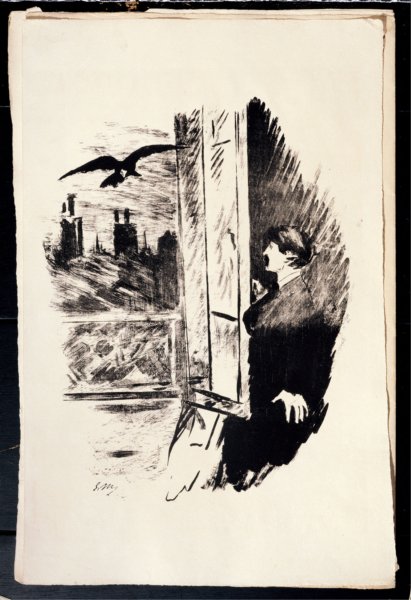
Édouard Manet, Lithograph, published with the poem “The Raven”, 1875

After some online research, I found that the Baltimore Art Museum recently had an exhibit that featured artists inspired by Edgar Allan Poe (The University of Virginia also had a similar themed exhibit). Poe’s writing is now in the public domain and much of his writing can be found online. The website The Literature Network has a thorough collection of Poe’s writing (If you do not see the links to Poe’s stories and poems on this site, look for the column on the left as you scroll down).

Odilon Redon, The Eye Like a Strange Balloon Mounts Toward Infinity, Plate 1 in the Series For Edgar Allan Poe, Lithograph, 1882

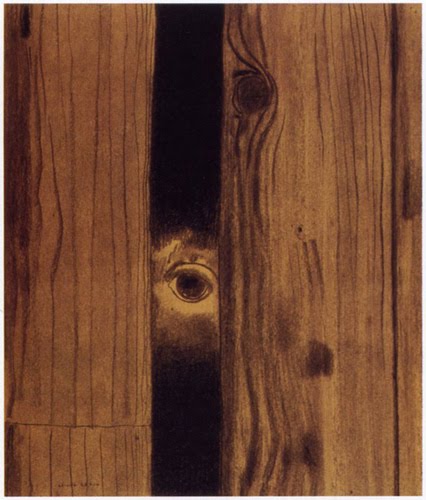
Artists for generations have been attracted to Edgar Allan Poe’s imagination, depth, and vividness.It is these qualities that pierce through the macabre for which his best literary works are known.Some artist’s like Edouard Manet have made more literal illustrations of Poe’s writing. Manet made lithographs to illustrate Stephane Mallarme’s French translation of “The Raven”. Artists Odilon Redon and Nathan Oliveira have made suites of prints inspired by Poe. For artists like Edvard Munch much of their art work is ladened with a mood akin to Poe’s writing.

Odilon Redon, After Reading Edgar Allan Poe, or: The Eye, Charcoal drawing, 1883

Life is ripe with paradox. For example, one cannot truly know the lighter side of life without feeling its darkness and despair. For all of Poe’s focus on the darker side of life, he also understood its opposite. For example,“The Pit and the Pendulum” is relentlessly dark. However, it would not be memorable without the light at the end.

Edvard Munch, Angst, Oil on Canvas, 1894

(For further reading about Redon’s connection with Poe see: Norbert Miller’s essay, pages 58-67, in the book Odilon Redon: As in a Dream. Also see: Nathan Oliveira, by Peter Selz, pages 3, 78-80, and 154)

Lost and Found Part 1

Currently, I am taking digital design classes at Bucks County Community College. Numerous prints are hung in one of my classrooms below the library. After observing the various styles and techniques represented, I noticed a print that looked familiar and seemed to be part of a series. I had seen another print that looked very similar on another part of the campus. Upon closer inspection I realized that the print found in my classroom and the other print I had seen were made by Pamela DeLaura.

I met Pamela on a trip to Detroit. She is a Professor of Printmaking at Wayne State University in Detroit. I sent her an email to confirm it was her work. She was surprised because it turns out the work came from her time as a graduate student at Temple University. She was not sure how the work became a part of the college collection but was pleased to know it fell into good hands.

The print I witnessed (seen above with some glare on the glass) is an interior with writing visible as part of the printed image. The writing describes what she saw out of her window when she was a child.

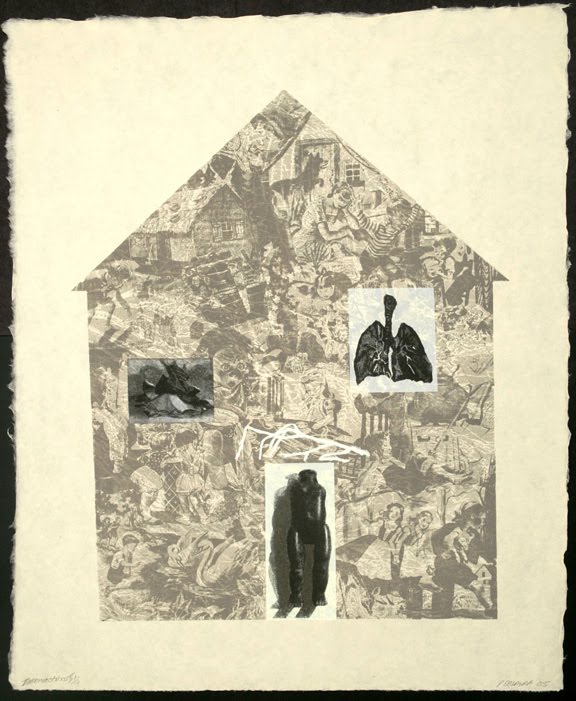
Pamela’s prints at Bucks County Community College seem to foreshadow her later work that depicts the form of a house filled with reminders and symbolic information. Below is an image of a more recent print by DeLuara that was included in a national print exhibit at Artlink in Fort Wayne, Indiana. Having lived for three years in the Midwest, I know that Artlink has been very active in support of contemporary art and printmaking. So, all is well. What was lost has now been found.

Pamela Delaura, Intersections III, 2005

Science and Art

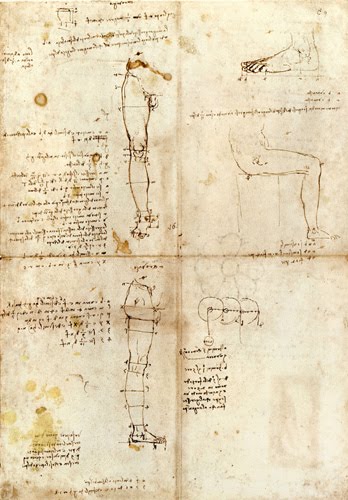
LeonardoVinci (1452-1519) is perhaps the artist most identified with science. The drawing above by Leonardo demonstrates his interest in proportion. Proportional study was critical to science during Leonardo’s lifetime because a standard system of measurement did not exist. Systems of measurements often varied from city to city (See Fritjof Capra’s excellent book The Science of Leonardo page 169).

Since the renaissance, technology has more often than not allowed artists and scientists to drift apart. There is still the need to illustrate, graph, and describe science with traditional artists tools. However, In the nineteenth and twentieth century a dramatic increase in scientific invention and information has ushered in an age of specialization where scientific understanding is no longer dependent on the artist’s power to observe and record. Electron microscopes, x-rays, and cameras small enough to be inserted in the body are now allowing scientists, engineers, and doctors to see in enhanced ways.

Although most artists are not deeply engaged in science and most scientists don’t have time to become full time artists, the two fields of study share many common aspects. For instance, both disciplines are likely to begin with studies or tests, comparison is key to both scientific and artistic analysis, perspective and observation remain critical, and finally imagination and creative thinking is essential to scientific and artistic development.

Art involves a study of life as it relates to the senses and intellect. So, we should see some connections between art and the techniques used for investigating our universe (scientific method). Art remains capable of presenting scientific findings in unique ways. Art can also provide a humanistic context for science that is capable of critiquing mankind’s use of science.

Below are examples of art that describe, critique, and presents science in a variety of ways. What is art and what is science can often be hard to separate. Notably, my initial inspiration for this post was a contest and exhibit titled The Art of Science that students at Princeton University take part in annually. The contest challenges students, who study a range of subjects, to consider science as art and art as science.

National public Radio had a series called “Where Science Meets Art” and one example from this series involves science told through comics. The artwork above is by Leland Purvis and Jay Hosler.

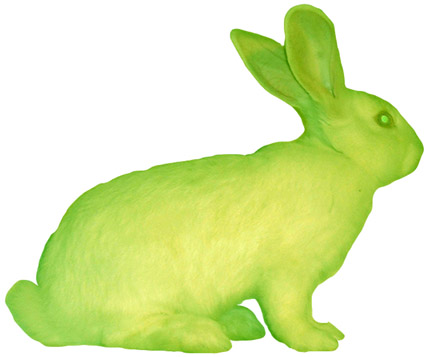
GFP Bunny is a genetically engineered rabbit by Eduardo Kac (born 1962).

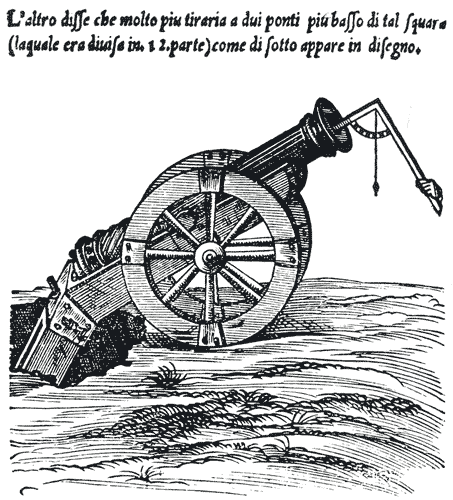
Based on study by Niccolo Fontana Tartaglia (1499/1500 – 1557) this illustration exhibits the relationship between geometric analysis, physics, and canon fire.


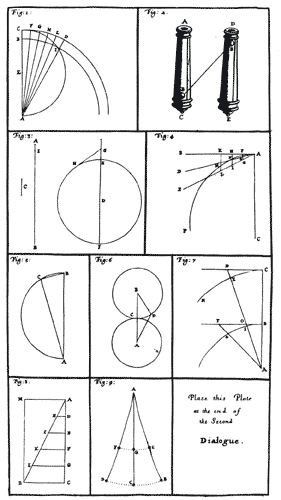
Galileo Galilei (1564-1642) said “Mathematics is the language with which God has written the universe.” This image is from Galileo’s Dialogues.


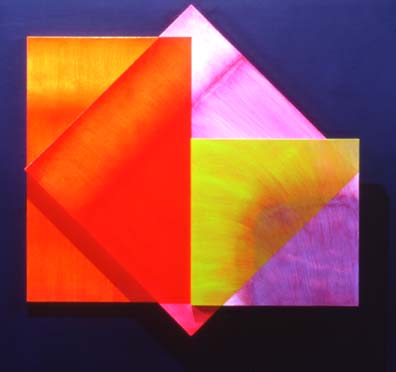
Dorothea Rockburne‘s (born 1932) work has also been inspired by a study of geometry. Above is her work: <Pascal’s Provincial Letters,

Here are links to other serious artists inspired by science: Beauvais Lyons, Beverly Fishman, Vija Clemins also on Art 21, Walter De Maria, and Damien Hirst. (I hope to add more soon)

Relief Prints


Lyonel Feininger (German/American 1871-1956), Volcano, 1918

This fall I am teaching relief printing as part of an introductory printmaking course. During the first class, I introduced examples of relief prints from art history. Many of these images are included in this post. After this presentation/lecture, students began to work on preparatory drawings that would lead them toward their own print. Although this stage of design can’t be seen in the prints shown here, during this sketch stage the treatment of one’s subject and its compositional layout can be considered and revised. Once a plan is made, the design is render on the surface of the carving block (usually linoleum or wood). When the drawing is in place then the remainder of the work revolves around carving and printing. Surprises can arise while carving, and adjustments can be made after a proof is printed. However, it is the initial planning which I believe to be the most critical to the success of this kind of print (one that relies on describing form).

The prints included in this post are related to German Expressionism and prints made in Mexico during the first half of the 20th century. When discussing these prints with the students, I asked them to notice how the negative space (the space around the main subject or subjects) can contribute to the organization of a picture. If the shapes that the negative spaces make are complex then this can lead to a more active image. Although a larger amount of white or black around a figure or subject can lead to a dramatic presentation, rarely is the background (or negative space) all white or all black in these examples. Here marks are often used to activate spaces that can be undervalued to the passive viewer. In other words, the type of mark made according to its width, length, and direction is integral and an important subject unto itself.


Francisco Dosamantes (Mexican 1911-1986), Scandal, 1945

Carving does not allow for shading but value differences can be created optically by the proximity of marks. The smaller and farther apart marks are the lighter a picture will appear. In other words, the more one carves the lighter the image will be when printed because there will be less raised surface area for the ink roller to make contact with. However, exceptions will occur when the printing method involves explicitly over inking the matrix or that the carved marks remain too shallow and collect ink.

Below are examples with notes and links. Some of the artists are less known and I am pleased to include them here because they made important contributions to the larger milieu of their time and culture.


Karl Jakob Hirsch (German 1892-1952), Self Portrait, 1915


Franz M. Jansen (German 1885-1958), 8 O’clock, 1920


Käthe Kollwitz (German 1867-1945), The Widow II, 1923


Isabel Villaseñor (Mexican 1909-1953) Self Portrait, 1929

I could not find a lot of information about Villaseñor. She was a poet and artist who also appears as a model in many well regarded photographs.


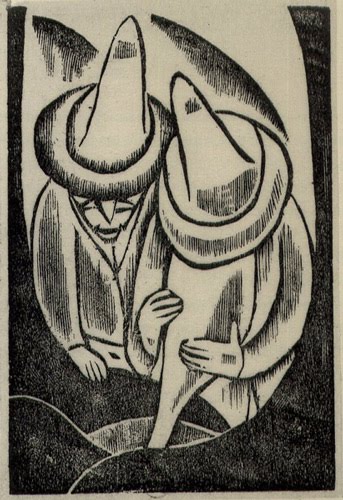
Tamiji Kitagawa (Japanese, 1894-1989) Extracting Sap from a Maguey Plant, 1930

Tamiji Kitagawa was born in Japan but came to live in Mexico.